🧬 Orchestrator-first · Bootstrap + Orchestrate · Runtime Truth

A local-first MCP control plane for
coding agents that need real runtime discipline.

Nexus Prime gives Codex, Cursor, Claude Code, Opencode, Windsurf, and Antigravity a default path that starts with memory/bootstrap context, routes file reads through token-aware planning, and executes through a bounded, verified runtime.

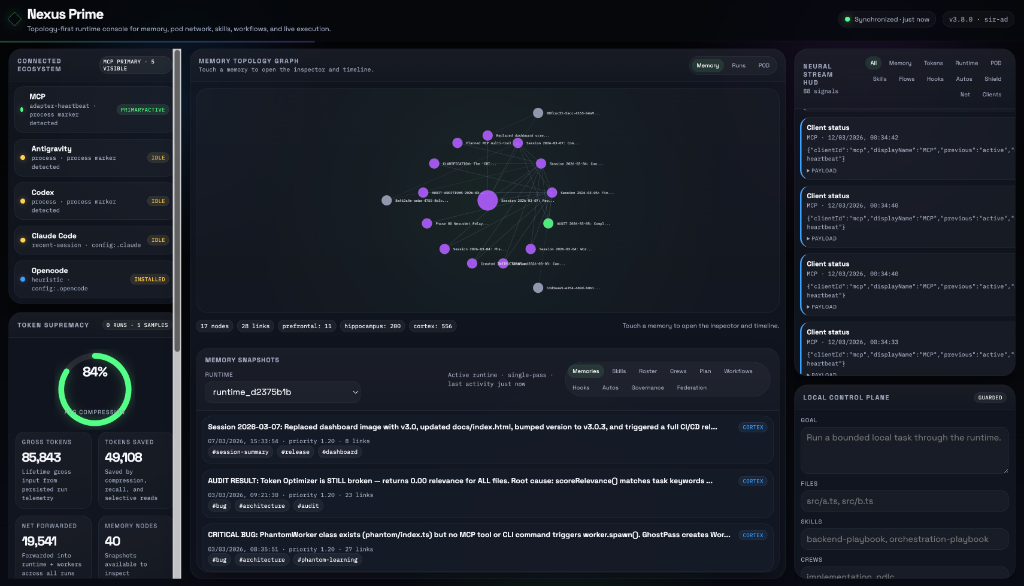
Nexus Prime dashboard showing runtime truth, token telemetry, knowledge fabric, and operator actions
Inspect the live runtime: lifetime token telemetry, runtime truth, knowledge provenance, and operator actions in one place.

Explore Nexus Prime without leaving the site.

Start with the core reference, jump into client setup, or review the runtime architecture before integrating Nexus Prime into your stack.

Runtime Sequence

The public contract is simple: bootstrap the session, let the orchestrator choose the runtime path, and inspect persisted runtime truth afterward. Phantom workers and the POD network remain behind that control plane.

sequenceDiagram participant U as User / Agent participant M as MCP Adapter participant B as Session Bootstrap participant O as Orchestrator participant G as Governance + Token Routing participant W as Phantom Workers U->>M: nexus_session_bootstrap(goal) M->>B: recall memory + inspect stats + shortlist assets B-->>M: recommended next step U->>M: nexus_orchestrate(prompt) M->>O: plan + select crews, specialists, skills, workflows O->>G: token routing + governance preflight G->>W: verified runtime execution W-->>O: artifacts + verifier results O->>O: persist packet, ledger, and token telemetry O-->>M: Final Result M-->>U: JSON-RPC Response
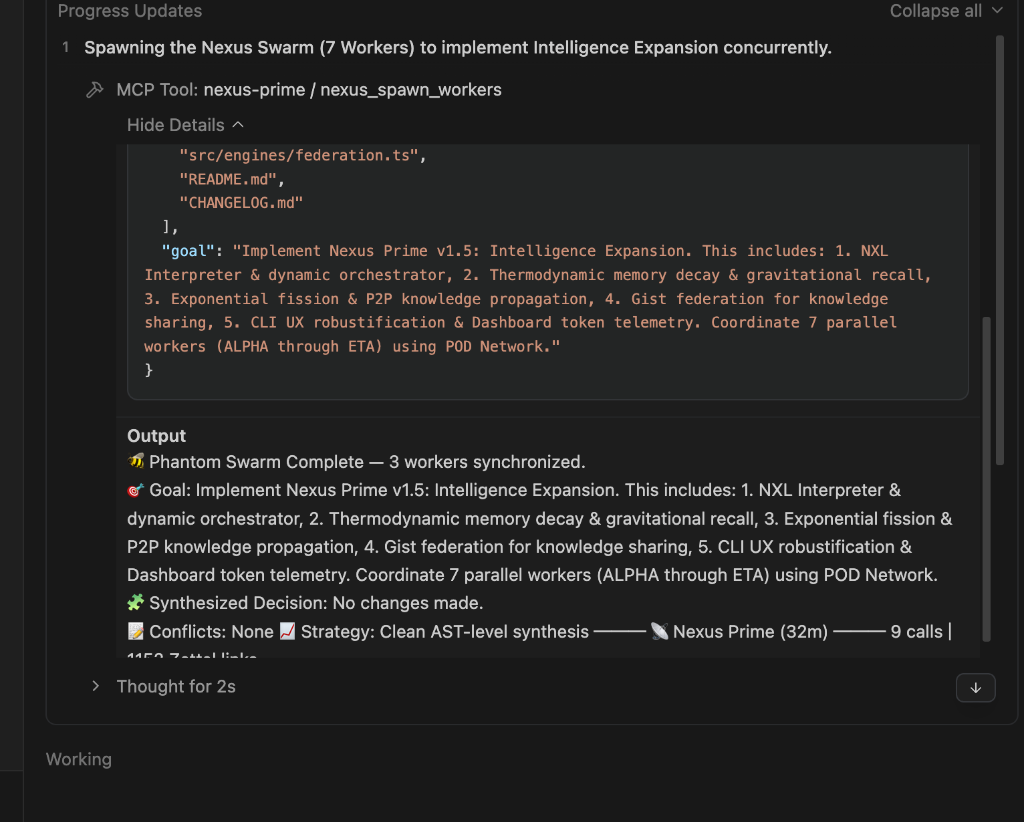
Swarm trace showing multiple worker nodes coordinating through the pod network
Mandatory Induction: A 7-worker swarm coordinating via POD Network.

The surfaces that matter in practice.

🧠

3-Tier Semantic Memory

Persistent recall plus session context so clients can start with prior learnings instead of browsing blind.

nexus_recall_memory
✂️

Lifetime Token Telemetry

Token-aware routing and persisted telemetry so the runtime can show what was compressed, forwarded, retrieved, or skipped.

nexus_optimize_tokens
🐝

Phantom Swarms

Verified worktree-backed execution with review gates, bounded continuations, and auditable artifacts.

nexus_orchestrate
🧭

Runtime Truth

Packets, ledgers, token timelines, hooks, automations, federation state, crews, and specialists all report from persisted runtime data.

/api/usage

Technical Specifications

Key implementation contracts without stale benchmark theatre.

📜 Language Specifics (NXL Specification)

The Nexus eXpansion Language (NXL) is a declarative syntax for swarm induction. It allows developers to define agent archetypes and behavior triggers without hard-coding logic.

# NXL Swarm Induction Spec
swarm: "ForensicAudit"
archetype: "DeepResearcher"
induction:
  trigger: "large_rewrite"
  threshold: 0.85
  capacity: 7_workers
  network: "private_pod"
  consensus: "byzantine_fault_tolerant"
📊 Operational Comparison

What changes when the client follows the bootstrap-to-orchestrate path instead of directly browsing and mutating.

Metric Standard Agent Nexus Prime
Context Retention Session-bound (Ephemeral) Persistent (Cross-Session)
Session Start Repo docs and ad-hoc exploration nexus_session_bootstrap
Execution Control Manual tool chaining nexus_orchestrate
Token Telemetry Often stream-only or absent Persisted totals + per-run analyzer
Runtime Truth Depends on the active host process Shared runtime snapshots
🛠️ Building on Nexus Prime (Integration API)

Extend the meta-framework by registering your own Skill Cards or hooking into the Evolution Engine.

  • Inject custom declarative skills via nexus_skill_register.
  • Implement state-aware adapters for external tool-chains.
  • Subscribe to the POD Network for inter-worker telemetry.

MCP Tooling Matrix

The full tool catalog is broader than this table. These are the operator-facing controls that should anchor client behavior.

Tool Name Core Capability Execution Tier
nexus_session_bootstrap Session-start memory, stats, shortlist, and next-step recommendation Core
nexus_orchestrate Raw-prompt autonomous execution path Core
nexus_store_memory Store semantic findings and insights Core
nexus_recall_memory Retrieve context across historical sessions Core
nexus_optimize_tokens Mathematical context reduction via Knapsack Optimization
nexus_plan_execution Inspect the execution ledger before a run Planning
nexus_spawn_workers Manual/diagnostic swarm control when explicit worker control is required Autonomy
nexus_mindkit_check Governance preflight for risky mutation Safety
nexus_list_skills, nexus_list_workflows, nexus_list_hooks, nexus_list_automations Inspect runtime assets when you want explicit control Runtime

Get from install to useful behavior quickly.

Install the MCP server, provision a client-native instruction surface, then verify the bootstrap-orchestrate path.

# Global installation

npm install -g nexus-prime

# Start the MCP server

npx nexus-prime mcp


# Automated Client Integrations

nexus-prime setup cursor

nexus-prime setup claude

nexus-prime setup windsurf

nexus-prime setup antigravity

nexus-prime setup status